Who the f@#% is Bob Schimel?
SCHIMELSCAPE
The Story of Bob Schimel
Designer. Architect. Engineer. Artist. Lifelong student of consciousness.
Instead of simply documenting a career, Schimelscape explores the journey of an artist whose work has continually searched for the connections between architecture, science, spirituality, technology, and the evolution of human consciousness. Over six decades, Bob Schimel has created thousands of drawings, paintings, sculptures, and speculative designs that invite us to imagine not only new objects, but new ways of seeing ourselves and our place in the universe.
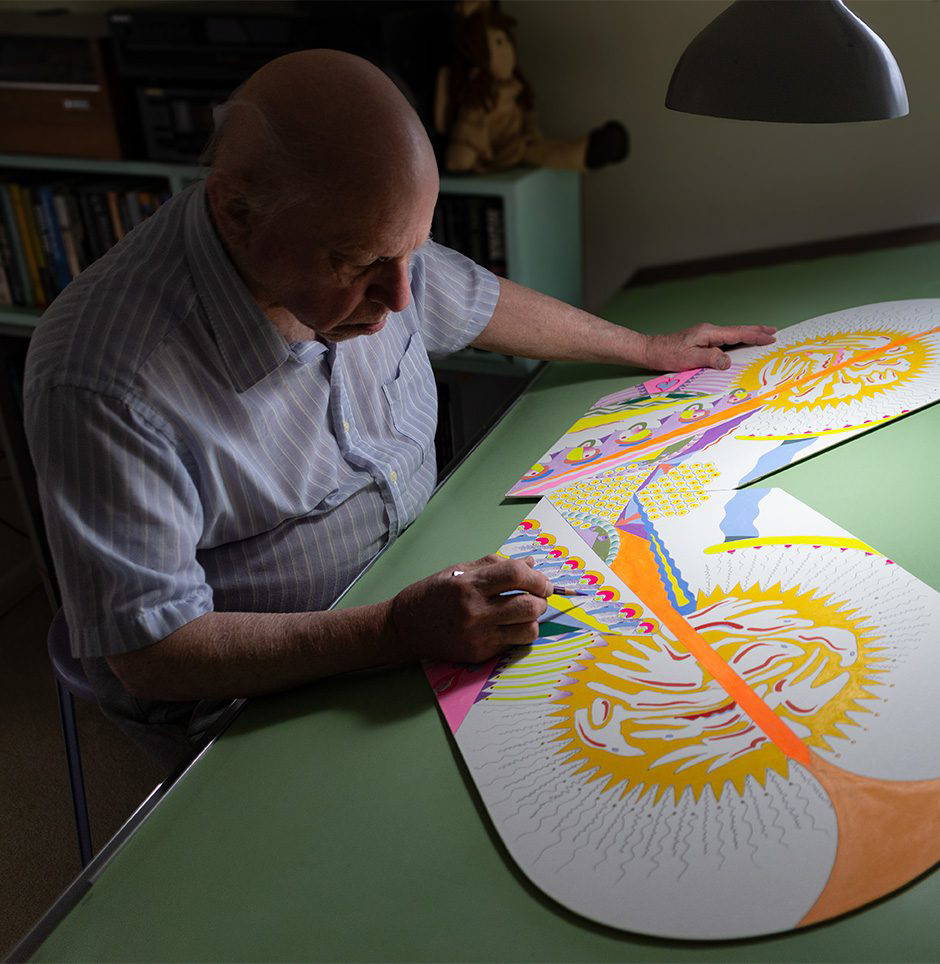
01.2025 — Bob Schimel working on his latest piece, inspired by his ongoing research and exploration.
Chapter One
A Curious Beginning
Long before Bob Schimel became known for imagining visionary cities, impossible machines, and speculative worlds, he was simply a curious observer of the one around him.
Growing up in Washington, D.C., he was surrounded by history, museums, monuments, and people from many different cultures. Those early experiences nurtured a fascination with how societies are shaped, how ideas evolve, and how people from different backgrounds understand the world in remarkably different ways. It was an environment that encouraged questions long before it offered answers.
“Growing up in Washington D.C. was exciting with all the history there, and I had friends from different countries.”
That sense of curiosity naturally led him toward architecture—not simply as a profession, but as a way of thinking.
In 1957, Bob entered the Rhode Island School of Design, earning a Bachelor of Fine Arts in Architecture in 1963. Rather than treating architecture as an isolated discipline, RISD exposed him to the broader relationship between design, observation, craftsmanship, and creative problem solving.
He continued his education at Cranbrook Academy of Art, where he received a Master of Fine Arts in Industrial Design, Architecture, and Graphic Communications.
“Those schools set the foundation for a continual probing into the Arts and Sciences.”
For many artists, formal education marks the beginning of a career.
For Bob, it marked the beginning of a lifelong search.
Over the decades that followed, he continued to place himself wherever new ideas were emerging. He worked with Nicholas Negroponte at MIT’s Architecture Machine in 1973, studied at the Art Center College of Design in Los Angeles, traveled to India to research at Sri Aurobindo Ashram and participate in the construction of the Matrimandir in Auroville, explored Mahayana Buddhism, Zen, and subatomic physics at Naropa Institute, and later embraced the possibilities of computer graphics at the Institute for Media Arts in Boston.
Each experience expanded his perspective. None replaced the last; each became another piece of an ever-growing body of knowledge that continued to evolve throughout his life.
By the end of the 1960s, it had already become clear that architecture alone would never contain his curiosity. The questions that interested Bob were becoming larger than any single discipline—and they would soon lead him far beyond the drawing board.
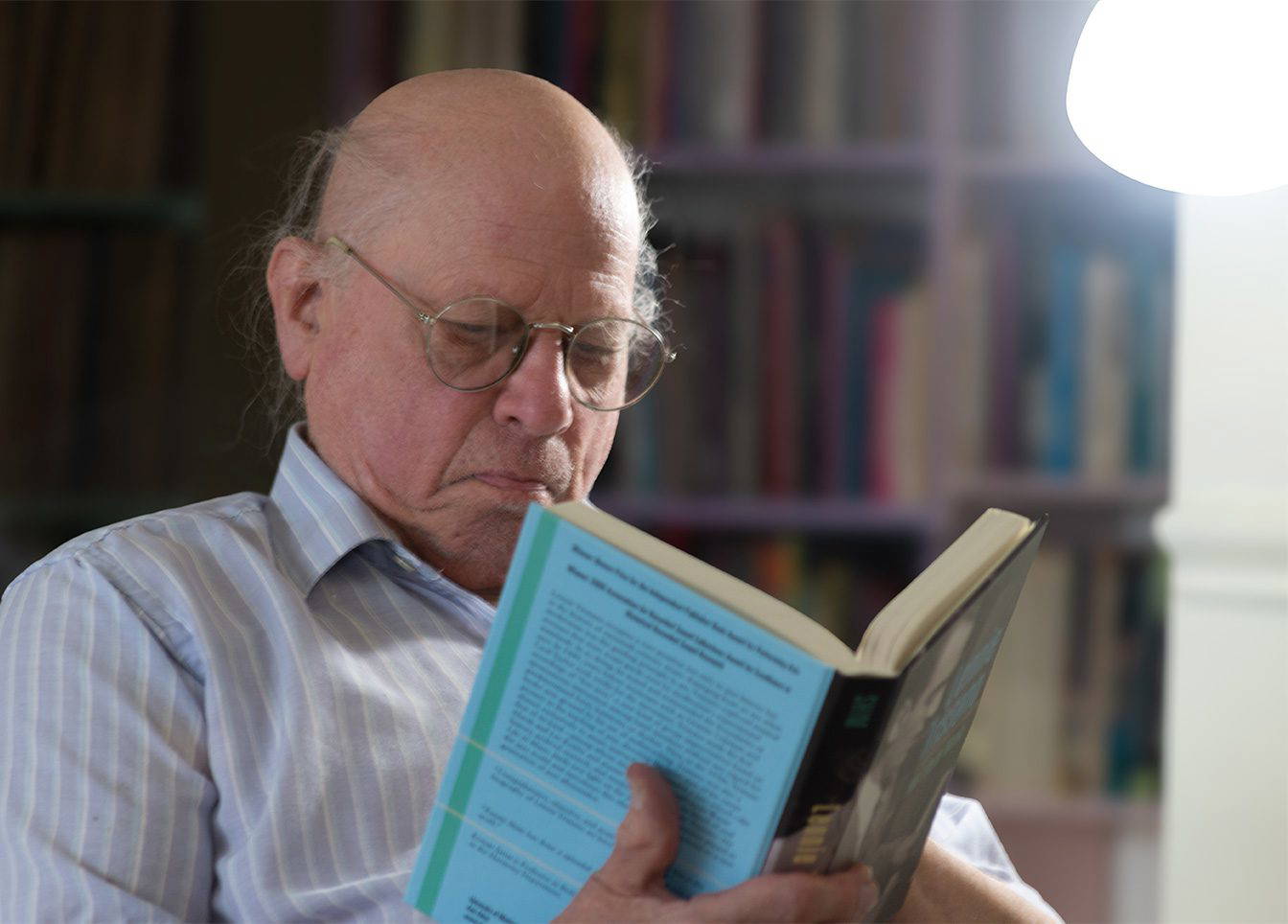
02.2025 — Bob Schimel continuing to dig deeper, exploring new ideas through research, experimentation, and creation.
Chapter Two
Looking Beyond Design
By the early 1970s, Bob Schimel had begun asking questions that traditional design alone could not answer.
Architecture had given him a foundation, but he found himself increasingly drawn toward larger questions about human creativity, culture, and the forces that shape the way we think. Design was becoming less about creating objects and more about understanding the ideas behind them.
“As a creative artist and designer, I was influenced and inspired by comparative theology and metaphysics.”
Rather than settling into a single profession, Bob continued to seek out people and places that challenged his assumptions. Every new experience became another opportunity to expand his understanding of how creativity might influence the future of humanity.
That search led him to the Massachusetts Institute of Technology, where he worked with Nicholas Negroponte and the pioneering researchers of the Architecture Machine Group. At a time when computers occupied entire rooms and digital design was still in its infancy, the group was already imagining how technology might transform the relationship between people, architecture, and intelligent systems.
For Bob, it was an environment unlike anything he had experienced before. Ideas flowed freely between architects, engineers, artists, programmers, and futurists, each exploring possibilities that seemed decades ahead of their time.
Yet the deeper Bob looked into technology, the more he became interested in the human mind itself.
His search soon carried him beyond universities and research laboratories. He continued his studies through comparative religion, Eastern philosophy, and emerging ideas about consciousness—not searching for certainty, but following questions wherever they seemed to lead.
“This was a very powerful experience of doing research and investigations into the evolution of consciousness.”
Looking back, these years were less a series of separate experiences than a continuous unfolding. Each encounter broadened Bob’s perspective and reinforced a growing belief that meaningful discovery often happens where different ways of thinking intersect.
The journey was gaining momentum.
Soon it would take him into the Arizona desert, where an architect named Paolo Soleri was asking many of the same questions through an entirely different language—that of cities, ecology, and the future of human civilization.
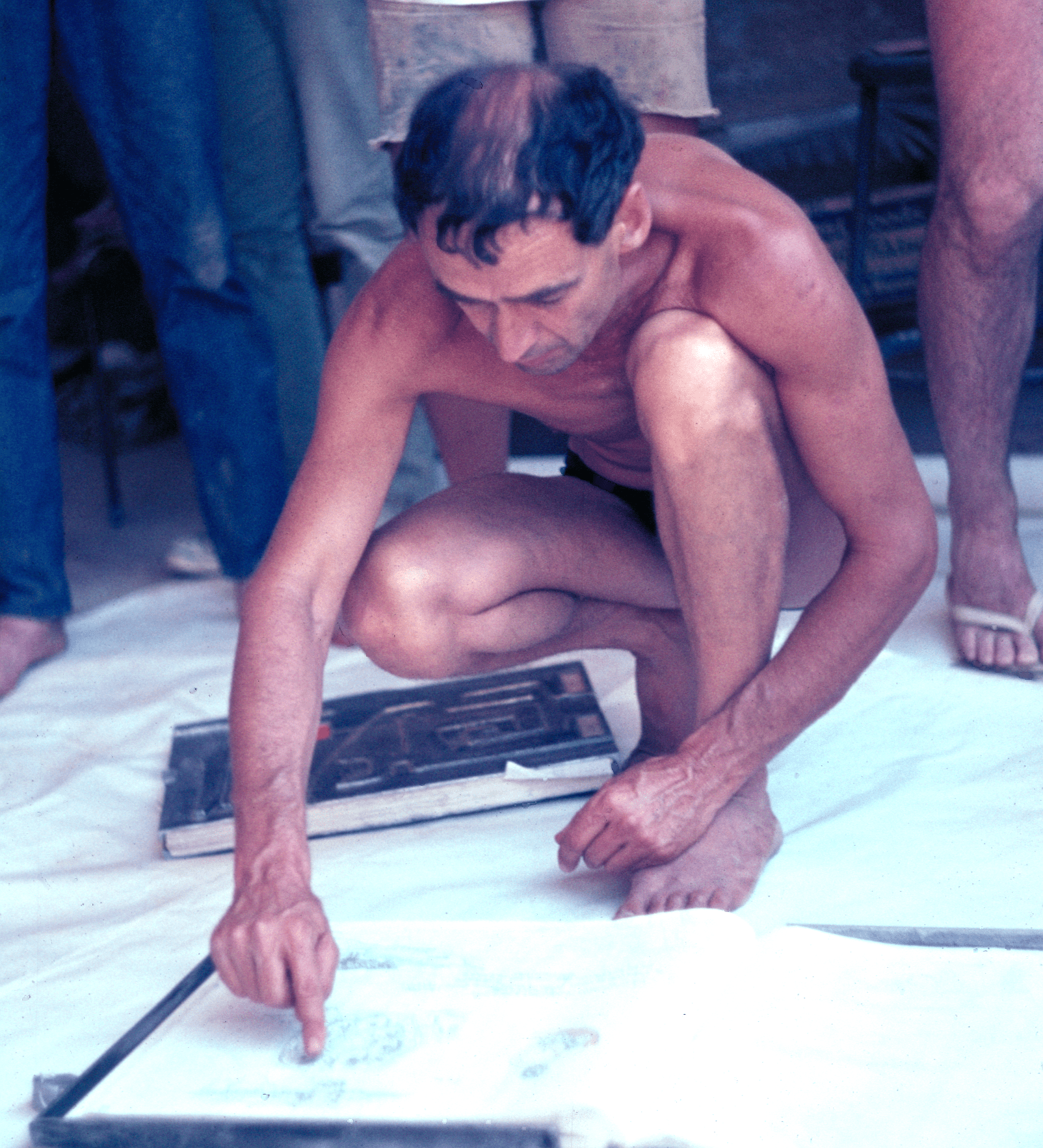
03.1972 — Paolo Soleri at work, translating ideas into form.
Chapter Three
Imagining the Future
By the late 1960s, Bob Schimel’s imagination was already reaching far beyond the conventional boundaries of architecture.
Rather than designing only for the present, he found himself asking a different kind of question: How might design serve humanity’s future?
In 1968, he became the first designer to create conceptual proposals for the Cryonics Societies of America. His speculative architectural environments explored the possibility of preserving human life for future rejuvenation—ideas that were remarkably forward-thinking for their time. The projects were later exhibited at Expo ’70 in Montreal, offering an early glimpse into Bob’s willingness to imagine futures that most people had never considered.
Yet one of the most significant influences on Bob’s life came not through a commission or exhibition, but through an apprenticeship.
In the Arizona desert, Bob joined the experimental community of Paolo Soleri, the visionary architect whose concept of arcology proposed that cities should function as living organisms—integrating architecture, ecology, community, and human experience into a single evolving system.
“My apprenticeship with visionary architect, Paolo Soleri, in Arizona, was a true growth experience.”
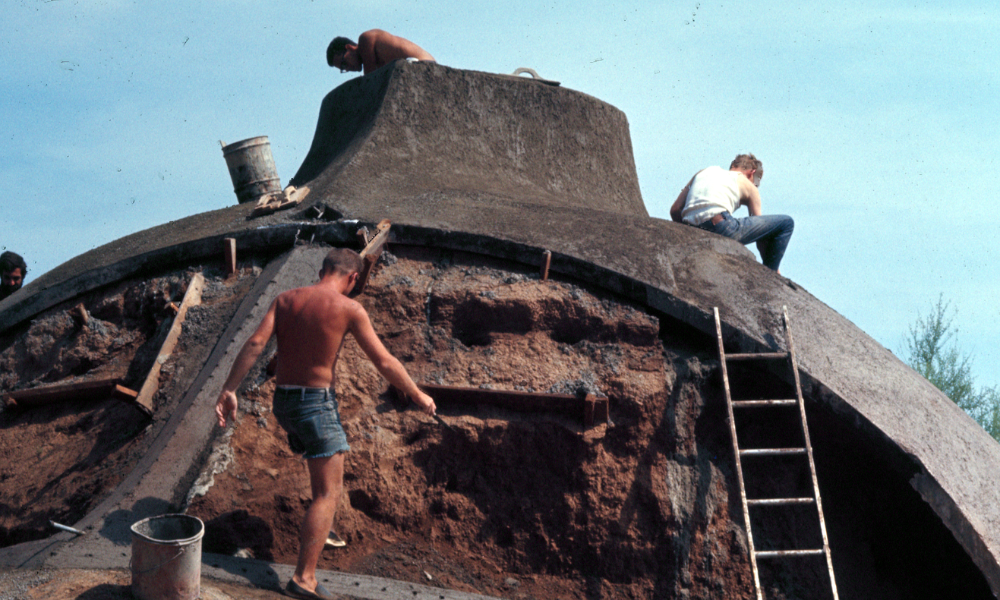
04.1972 — Interns at work building Cosanti, Paolo Soleri’s workshop and studio, using earth casting to shape its distinctive architectural forms.
Life at Soleri’s studio extended well beyond the construction site.
Days were spent building experimental structures by hand. Evenings became conversations that often stretched late into the night, as artists, architects, and students gathered to exchange ideas about philosophy, society, ecology, and the future. For Bob, the work and the discussions became inseparable.
“He is a very warm person to work with, and we all used to sit around and discuss philosophy after the day’s work was finished.”
The experience left a lasting impression.
Soleri demonstrated that architecture could be more than buildings. It could become a framework for exploring how people live together, how communities evolve, and how design might encourage a more thoughtful relationship with the world around us.
Those ideas resonated deeply with Bob—not because they provided answers, but because they encouraged bigger questions.
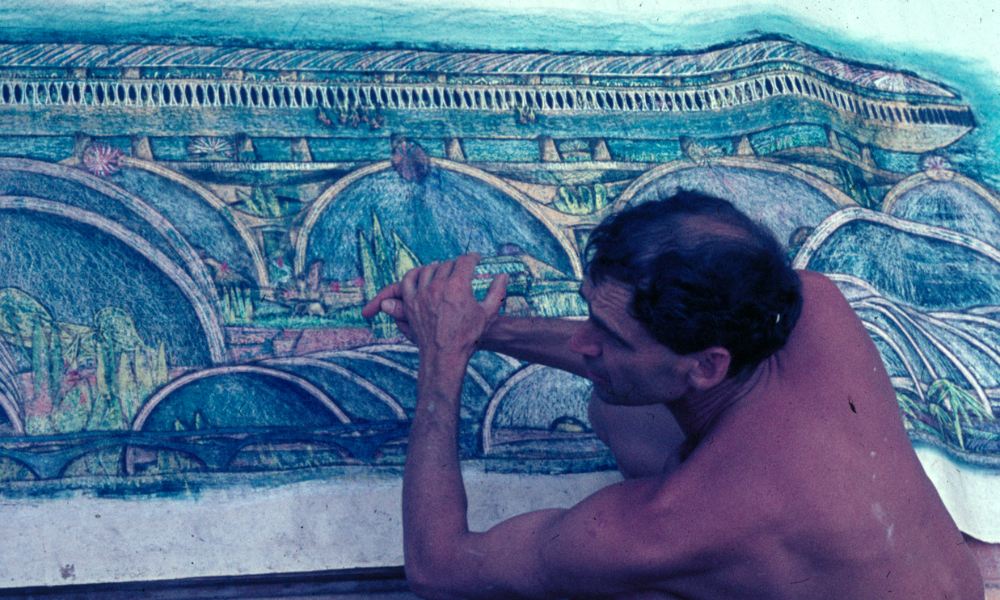
05.1972 — Paolo Soleri looks over his rendering of the future.
Many of the themes that would later emerge throughout his drawings—the fusion of organic and mechanical forms, speculative environments, evolving civilizations, and visionary structures—began to take shape during this period. Arizona became less a destination than a catalyst, expanding Bob’s understanding of what creativity itself could become.
That search was far from over.
The next chapter of the journey would carry him halfway around the world, where another community of builders and thinkers would deepen—and ultimately transform—the direction of his life’s work.
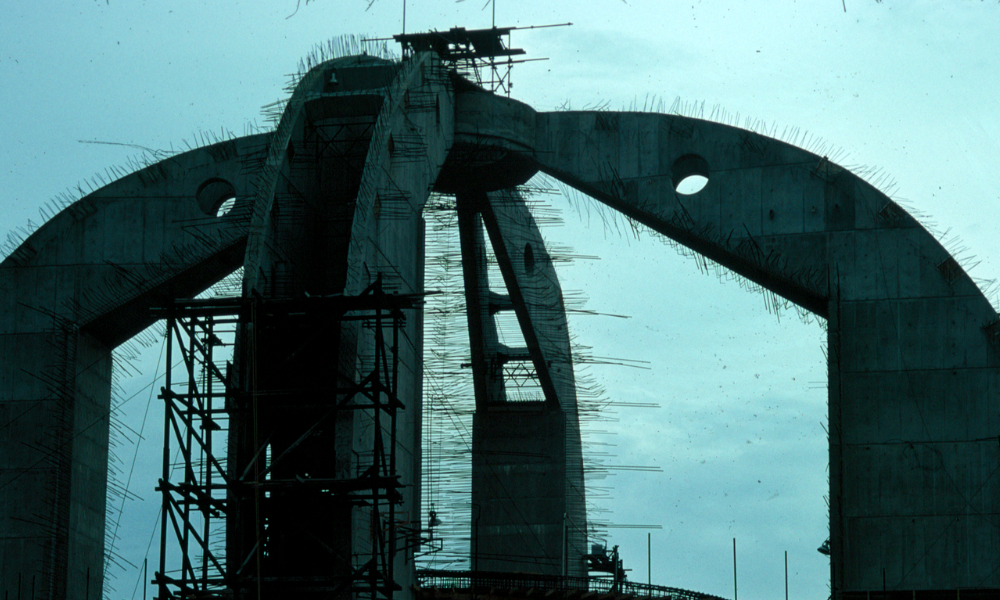
06.1976 — The Matrimandir rises in Auroville, India, as its iconic form begins to take shape.
Chapter Four
India: A Different Way of Seeing
In 1976, Bob Schimel traveled to India to continue a search that had been unfolding for years.
Drawn by a growing interest in consciousness and human potential, he spent time at Sri Aurobindo Ashram and the emerging international community of Auroville. There, he joined people from around the world in the construction of the Matrimandir—a place envisioned not as a temple of any religion, but as a space dedicated to inner reflection and humanity’s shared future.
“This was a very inspirational time.”
Life in Auroville brought together people of different nations, cultures, professions, and beliefs, all working toward a common purpose. Daily life blurred the distinctions between learning, building, and contemplation. The process of creating something together became just as meaningful as the structure itself.
For Bob, the experience reinforced an idea that had been quietly growing throughout his education and travels: the most interesting questions rarely belonged to a single field of study. Every new perspective added another way of understanding the same larger mystery.
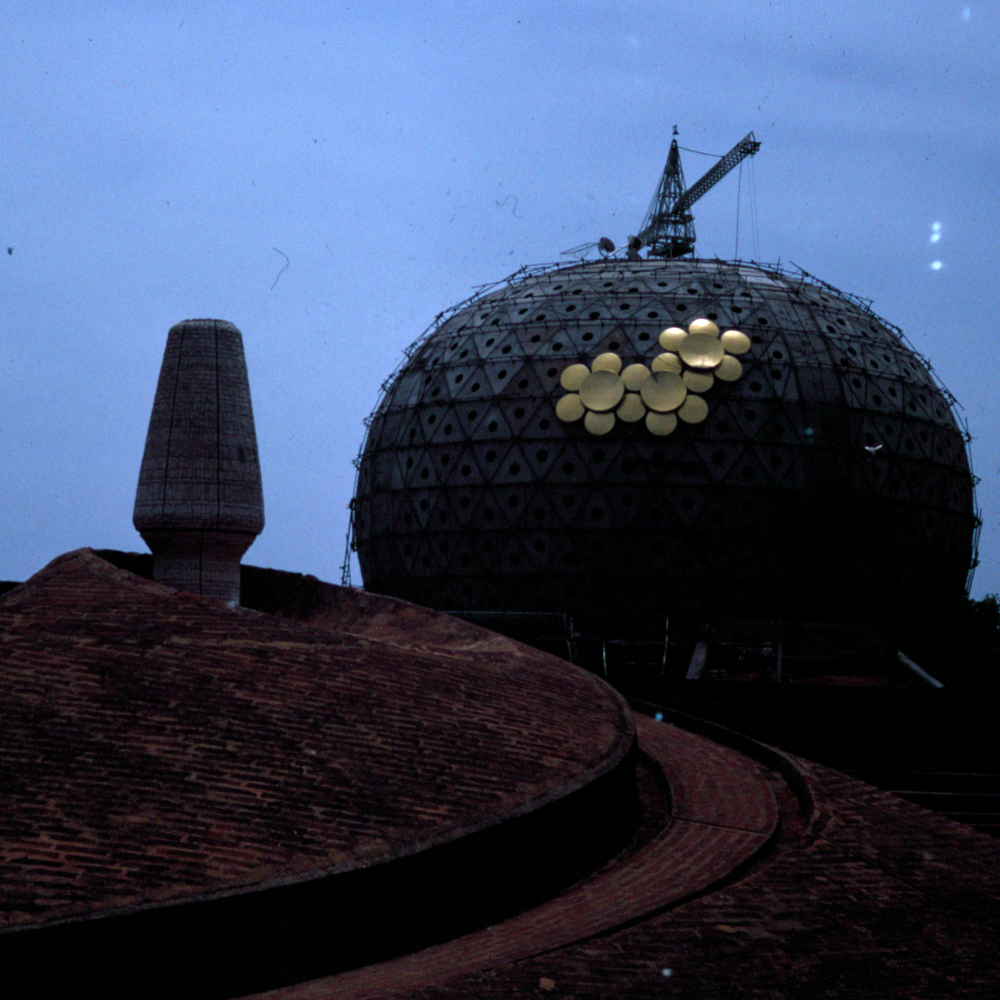
07.1976 — The Matrimandir begins its transformation, as the first golden discs emerge across its monumental form.
India did not change Bob’s direction so much as deepen it.
He returned home with renewed clarity and purpose, carrying forward an expanded perspective that gradually found its way into his creative work. His drawings became increasingly symbolic and exploratory. Visionary architecture merged with organic forms. Mechanical systems seemed to evolve like living organisms. Ancient symbolism and imagined technologies began to occupy the same visual space—not to explain one another, but to invite new ways of seeing.
Looking across Bob’s work today, this period stands as a quiet turning point.
The years that followed produced some of his most imaginative and thought-provoking creations—not because he had found definitive answers, but because he had become even more committed to asking meaningful questions.
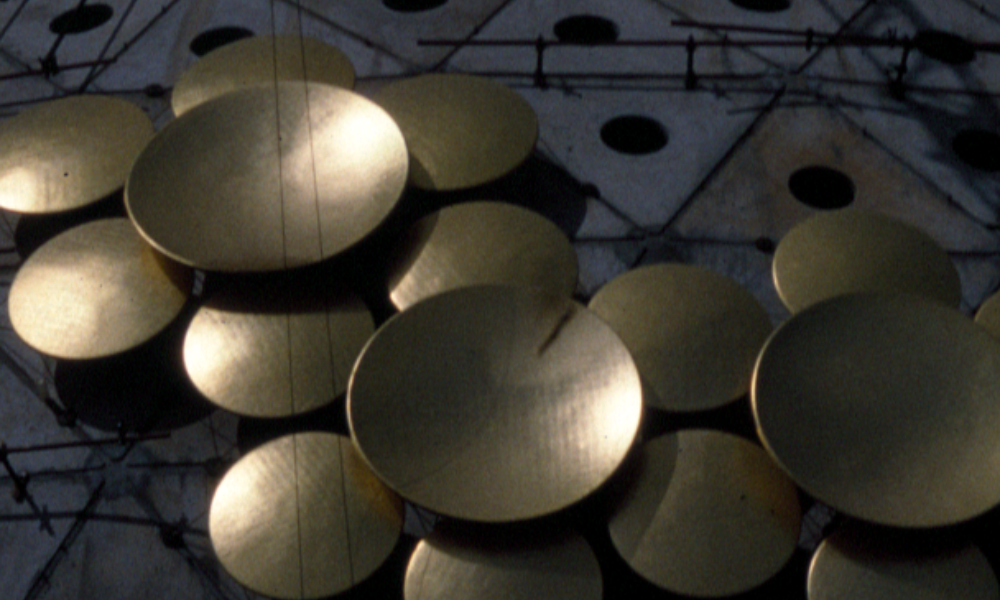
08.1976 — The surface of the Matrimandir takes shape with its distinctive golden discs.
Chapter Five
Cosmoyantra Designs
Over more than six decades, Bob Schimel has created thousands of drawings, paintings, sculptures, models, writings, and speculative designs. Viewed individually, each work tells its own story. Together, they reveal a remarkable lifetime of curiosity, imagination, and creative exploration.
As this collection continued to grow, it became clear that it represented something larger than any single project or medium. To bring these diverse works together under one shared identity, the name Cosmoyantra Designs was adopted.
The name combines Cosmo—the ordered universe—with Yantra, the Sanskrit word for an instrument or symbolic diagram used for contemplation and transformation. Together, the words reflect many of the themes that visitors will encounter throughout Bob’s work: exploration, possibility, imagination, and an enduring curiosity about our place within a much larger universe.
Rather than defining a single artistic style, Cosmoyantra Designs serves as an invitation.
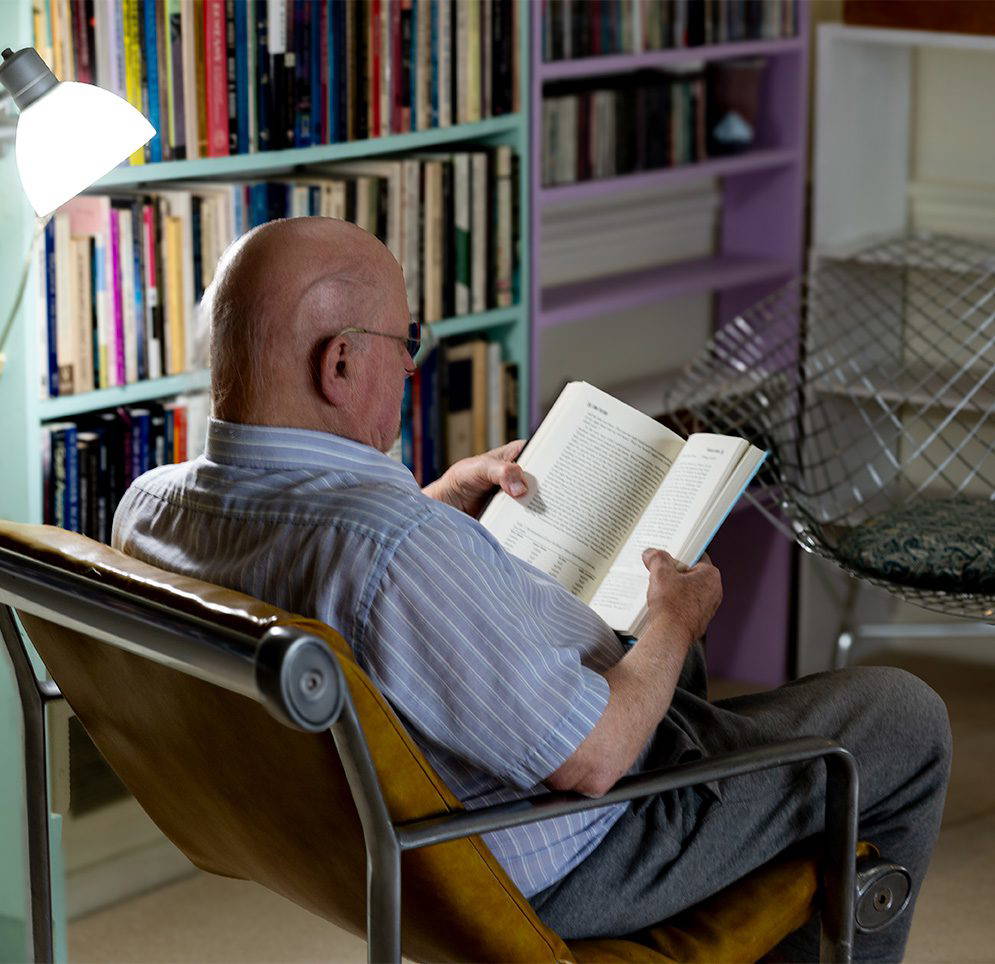
09.2025 — Bob Schimel still searching. Still questioning. Still digging deeper.
Some works resemble visionary architecture. Others appear as imagined machines, mysterious artifacts, biological forms, or fragments from civilizations that have yet to exist. Many resist easy explanation altogether, encouraging viewers to bring their own imagination to the experience.
Bob has never been interested in telling people exactly what to think.
His drawings rarely provide definitive answers. Instead, they invite questions. They encourage us to pause, look more carefully, and discover connections that might otherwise go unnoticed. What one person sees as a futuristic city, another may experience as a living organism, a sacred object, or an entirely personal memory.
That openness has always been part of Bob’s creative process.
Throughout his career, he has approached each new drawing not as an illustration of a predetermined idea, but as an opportunity for discovery. The image often reveals itself through the act of making, evolving one line at a time until unexpected relationships begin to emerge.
Cosmoyantra Designs is offered in that same spirit.
It is not a movement, a manifesto, or a single interpretation of Bob Schimel’s work. It is simply a place where a lifetime of creative exploration comes together—an invitation to slow down, remain curious, and begin exploring for yourself.
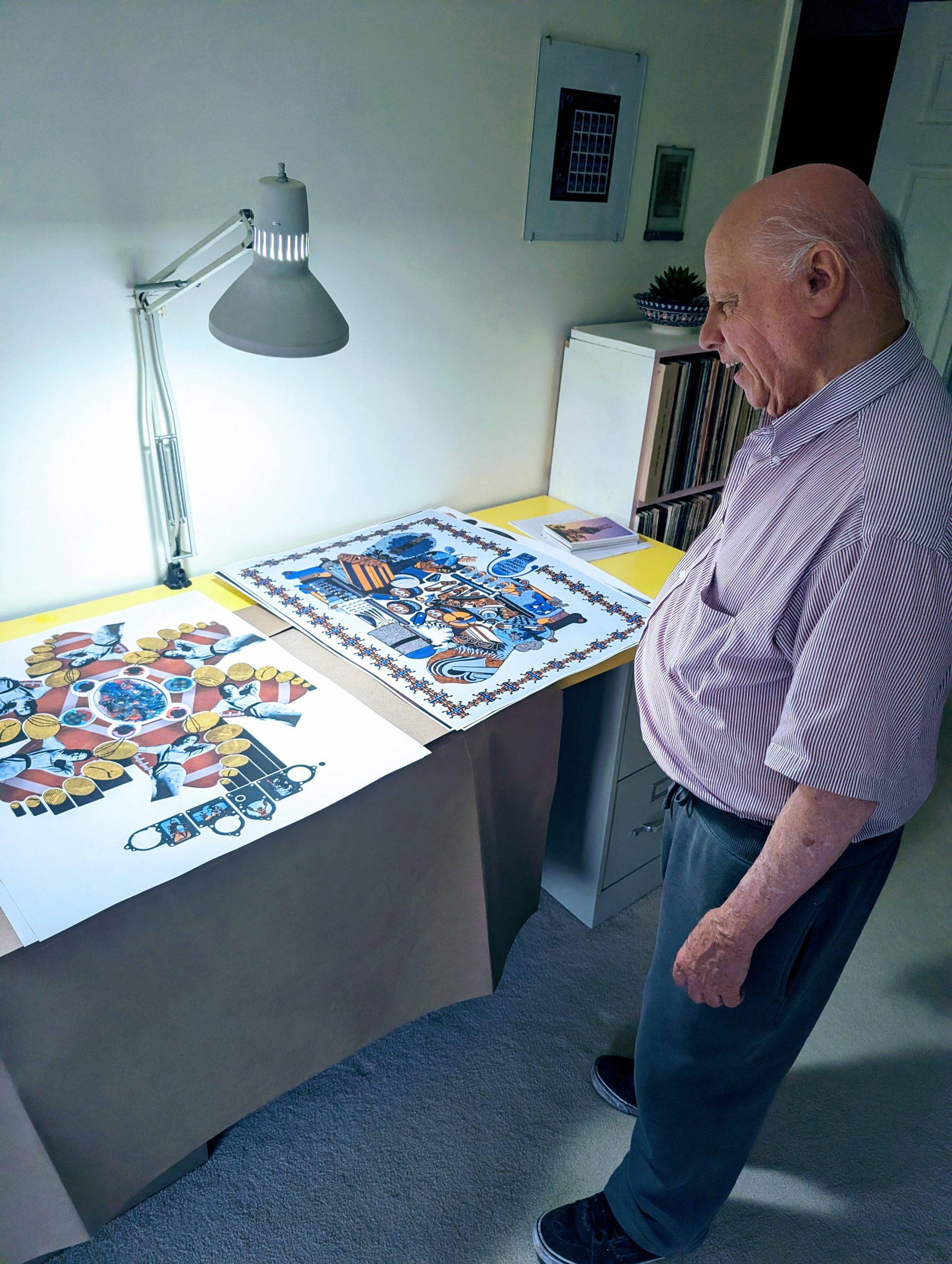
10.2026 – Bob Schimel revisiting decades of ideas through newly printed editions of his earlier work.
Chapter Six
Sharing the Vision
For much of his career, Bob Schimel worked quietly, following his own curiosity rather than artistic trends or commercial expectations.
Yet ideas have a way of finding people.
“My studio work has been controversial, and a number of international magazines have published the work.”
Beginning in the late 1960s, Bob’s drawings and speculative designs began appearing in architecture, design, and art publications around the world. Journals such as Domus, Architectural Design, Casabella, Leonardo, and Future Life introduced his work to readers who were equally interested in imagining new possibilities for design, technology, and the future.
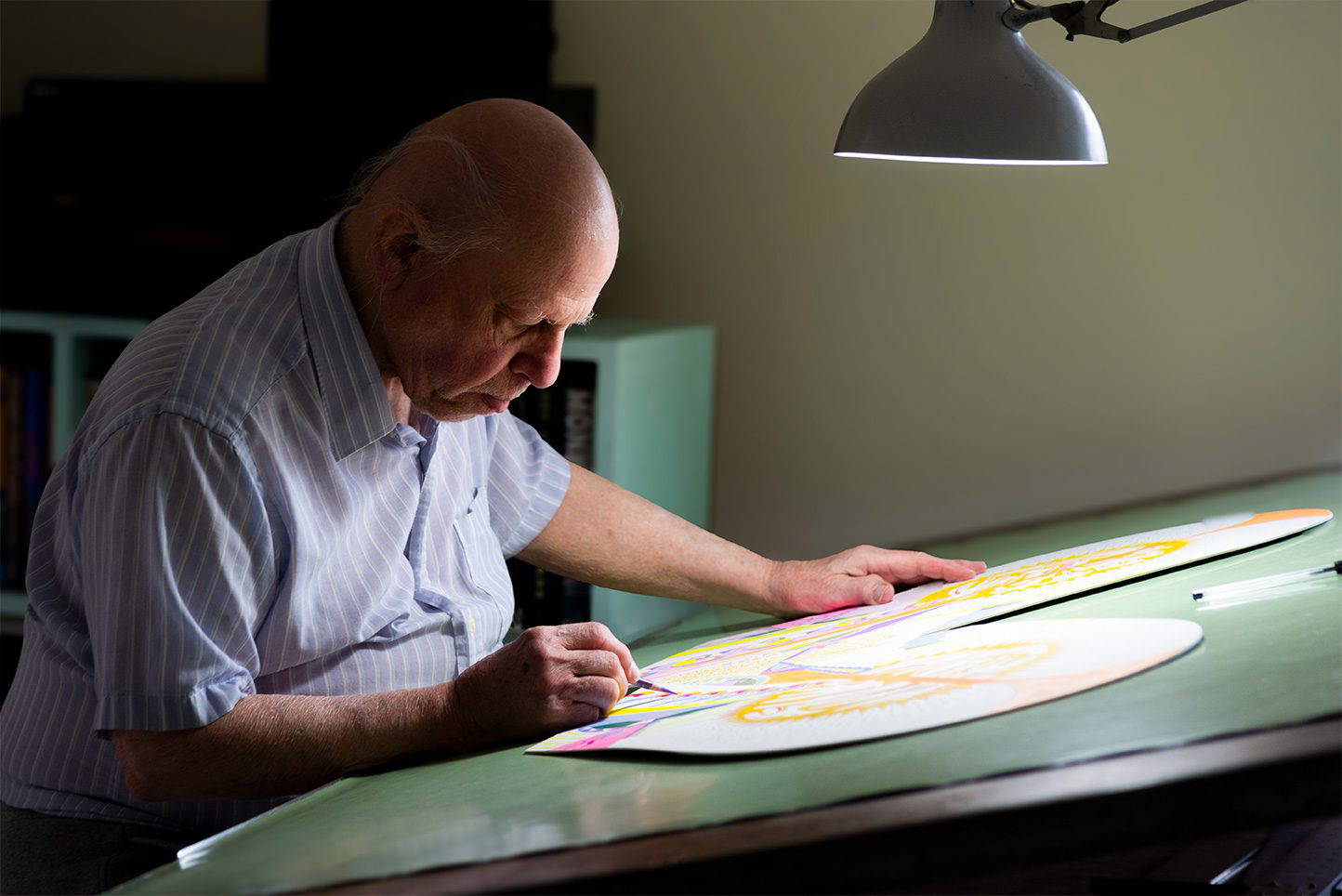
11.2025 – Bob Schimel turning a lifetime of research, questions, and ideas into something new.
His illustrations also appeared in books exploring cryonics, consciousness, music, and emerging ideas about human civilization, reaching audiences well beyond the traditional art world.
The conversation continued to grow.
Bob’s experimental video Just Passing Through was selected for both the Tokyo and Toronto Video Festivals, where it was recognized for its pioneering use of video synthesizer technology. In Poland, exhibitions including Now and Beyond Time in Warsaw and the first MoMia Conference on Meditation and Art in Wrocław introduced his work to communities exploring the relationship between creativity and human awareness.
For Bob, these moments were never destinations.
Each publication, exhibition, and collaboration became another opportunity to exchange ideas with people asking similar questions. Recognition was never the objective. Curiosity remained the constant.
Looking back today, what is perhaps most remarkable is how contemporary many of these works now feel. Drawn decades before conversations about artificial intelligence, biotechnology, space habitation, or emerging technologies entered everyday life, many of Bob’s images seem unexpectedly at home in the twenty-first century.
Not because they predicted the future.
But because they were never really about the future.
They were about possibility.
“Running Faster = Jumping Higher.”
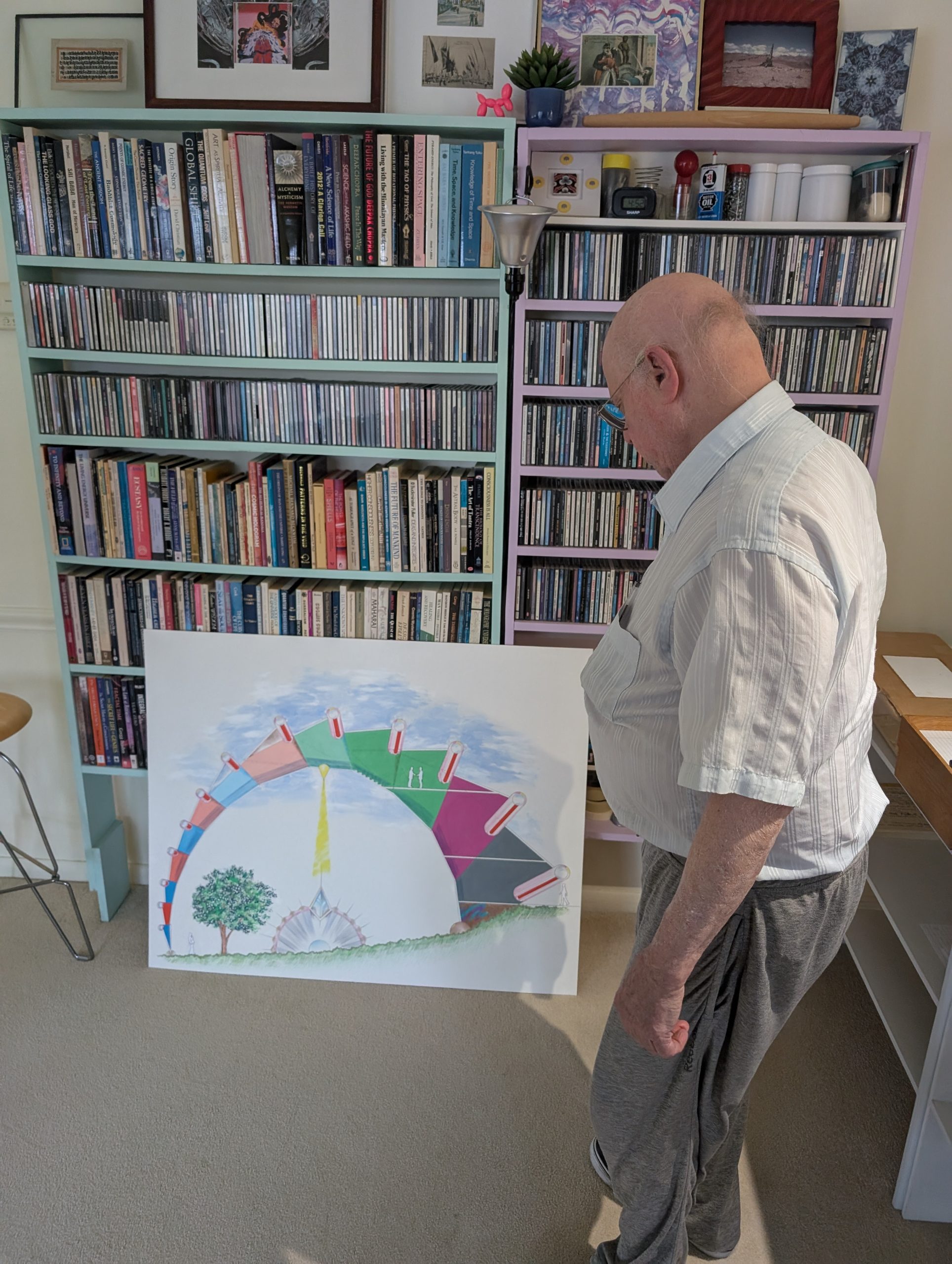
12.2024 – Bob Schimel last concept rendering for Evolutecture
Chapter Seven
The Journey Continues
More than six decades have passed since Bob Schimel first began exploring the ideas that would shape his life’s work.
Yet the search continues.
His notebooks remain filled with sketches, diagrams, observations, and new questions. Each drawing becomes part of an ongoing conversation—one that has never been driven by the pursuit of recognition or final answers, but by an enduring curiosity about what might still be discovered.
The world has changed dramatically over the course of Bob’s career. Technologies once imagined now shape everyday life, and many of the questions that first captured his imagination continue to inspire new generations of artists, designers, scientists, and explorers.
What has never changed is Bob’s willingness to remain a student.
To keep asking.
To keep imagining.
To keep creating.
Perhaps that is the most enduring lesson found throughout his work.
Curiosity is not something we leave behind. It is something we continue to practice.
As you explore the pages of Cosmoyantra Designs, you are invited to bring your own questions, your own interpretations, and your own imagination to the journey. There are no correct answers here—only opportunities to see something in a new way.
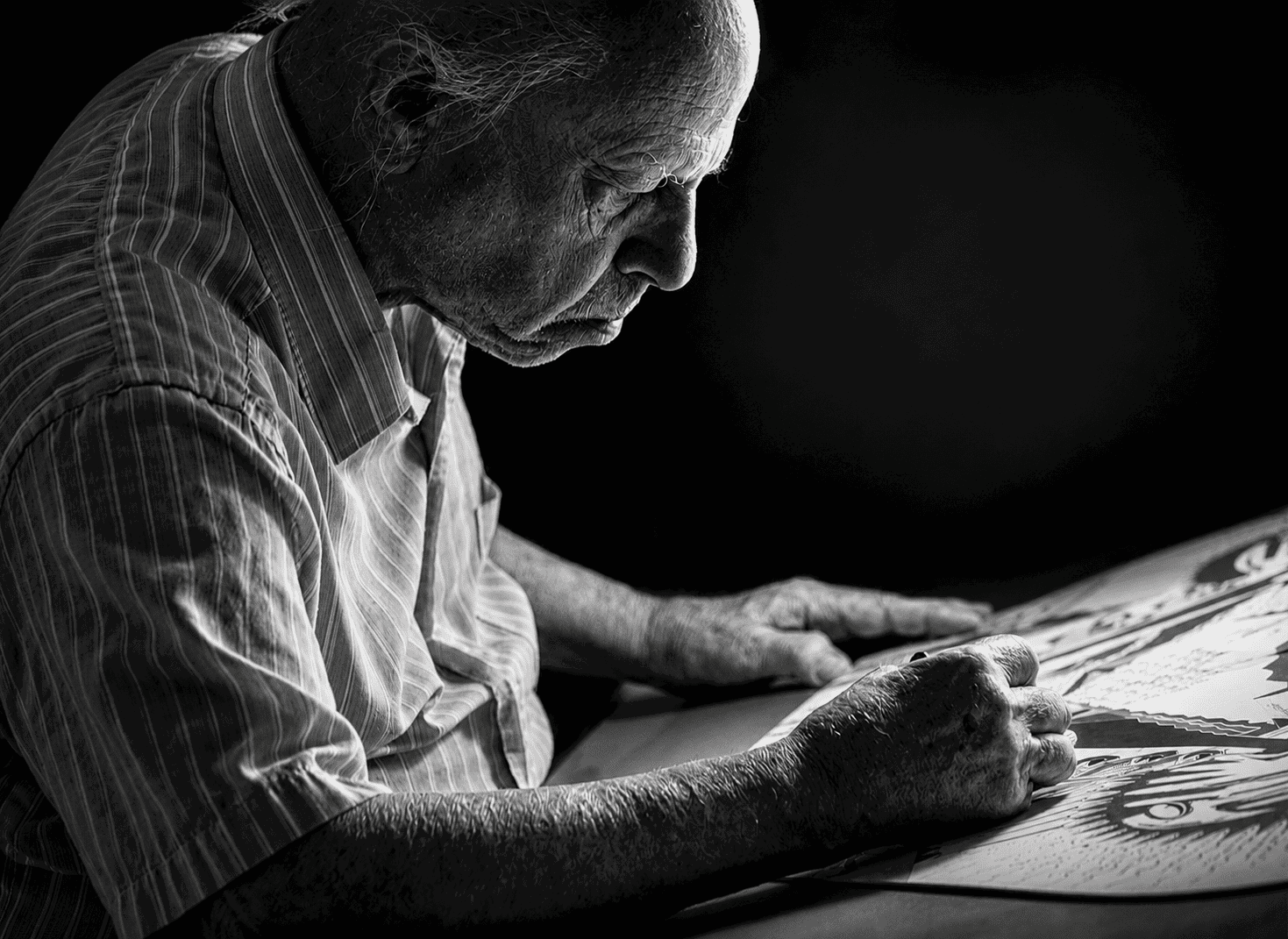
“We are living in a very interesting transitional time. I really do feel fortunate and humbled to be involved in such spiritual work.”

Education
1957 – 1961
Rhode Island School of Design, Providence, R.I.Architecture, Interior Design, Furniture, Textiles. BFA.
1963 – 1965
Cranbrook Academy of Art, Bloomfield Hills, Mich.Industrial Design, Architecture, Graphic Communications. MFA.
1973
Massachusetts Institute of Technology, Cambridge, Mass. Computer technology graphics. The Architecture Machine, with Nicholas Negroponte.
1974
Art Center College of Design, Los Angeles, California
1976
Sri Aurobindo Ashram, Pondicherry, South India, Auroville, Matrimandir Construction Camp. Research and Investigations into the Evolution of Consciousness.
1977
Naropa Institute, Boulder, Colorado. Sub-Atomic Physics, Madhyamika Philosophy, Zen Buddhism, Tantra.
1982
Institute for Media Arts, Boston, Massachusetts Computer graphics, with Tom DeFanti and Copper Giloth SIGGRAPH Conference on Computer Graphics 1982, 1983.
Creative Work Shown in Publications
London March 1969 – ARCHITECTURAL DESIGN
Italy June 1969 – DOMUS
USA June 1968, December 1968, 1969, 1970 – CRYONICS REPORTS
Italy June 1970 – DOMUS
London March 1970 – ARCHITECTURAL DESIGN
Italy September 1970 – CASABELLA
London November 1970 – DESIGN
London March 1971 – ARCHITECTURAL DESIGN
Scandinavia August 1971 – MOBILIA
Germany September 1971 – MOEBEL DESIGN
Germany October 1971 – MOEBEL DESIGN
USA December 1971 – INDUSTRIAL DESIGN
USA 1971 – LIFE, THE UNKNOWN, THE ENIGMA OF HUMAN SURVIVAL
London March 1972 – ARCHITECTURAL DESIGN
France July 1972 – CREATIONS ET RECHERCHES ESTHETIQUES EUROPEENES
France September 1972 – L’ARCHITECTURE D’AUJOURD’HUI
France November 1972 – L’ARCHITECTURE D’AUJOURD’HUI
Switzerland November 1972 – BAUEN UND WOHNEN
Switzerland February 1973 – BAUEN UND WOHNEN
France June 1973 – L’ARCHITECTURE D’AUJOURD’HUI
France July 1973 – CREATIONS ET RECHERCHES ESTHETIQUES EUROPEENES
Germany October 1973 – MOEBEL DESIGN
Germany February 1975 – MOEBEL DESIGN
London March 1975 – ARCHITECTURAL DESIGN
USA May 1975 – INDUSTRIAL DESIGN
USA May 1975 – LIGHTING DESIGN AND APPLICATION
Germany April 1975 – MOEBEL DESIGN
London July 1975 – ARCHITECTURAL DESIGN
Germany October 1975 – MOEBEL DESIGN
USA 1978 – THE RUBBER STAMP ALBUM
USA April 1980 – TESTUBE
USA December 1980 – TESTUBE
USA June 1981 – FUTURE LIFE
USA Summer 1981 – GLASS STUDIO
USA Summer 1981 – TESTUBE
Europe Vol. 15, No. 2 1982 – LEONARDO
USA #16, Winter 1983 – LIGHTWORKS
USA 1984 – JUST PASSING THROUGH VIDEOTAPE
USA Winter 1985 – L5 SOCIETY VIDEOTAPE (Space Development)
CANADA 1989 – MUSIC-ITS BENEFICIAL AND HARMFUL EFFECTS
USA 1989 – Brochure, CALIFORNIA INSTITUTE OF
INTEGRAL STUDIES